

Daniel O’Connell, His Dates in Dublin 8
by Dublin City Council Historian in Residence, Cathy Scuffil
Griffith College, South Circular Road (Formerly Griffith Barracks, Wellington Barracks and Richmond Bridewell Penitentiary)
Daniel's Date: September 1844
The landmark building of Griffith College on Dublin 8’s South Circular Road, with extensive grounds and outbuildings extending to the Grand Canal, was originally built in 1813 as the Richmond Bridewell Penitentiary, a place where mainly debtors were held.
The location of a penitentiary here had an adverse effect on housing development, and as late as 1844, the road was still rural and had an incomplete appearance. House building only commenced when the penitentiary was converted as the Wellington military barracks.One of the most famous prisoners to be held in Richmond Penitentiary was Daniel O’Connell, when he, his son John and a small number of allies, were arrested on a charge of conspiracy. This was as a result of speeches given at huge ‘monster meetings’ which hoped to pressure the British government to restore the Irish parliament, dissolved in 1801.
When arrested, O’Connell and his allies were allowed a choice of their place of incarceration. They opted for Richmond Penitentiary located on the South Circular Road. They were so well looked after, it became known as the ‘Richmond Picnic’. O’Connell delayed his release from prison for one day, in order that a massive celebration could be arranged. He departed Richmond Peneteniary on the back of an open chariot-style carriage, and was driven around the area to cheering crowds of supporters, a moment captured forever by the Illustrated London News.

St James’s Roman Catholic Church, James’s Street
Daniel's Date: 04 April, 1844
A familiar sight and social focus for Dublin 8 locals is the fine Roman Catholic church of St. James on James’s Street. The building, designed by Patrick Byrne, is a great example of the work of skilled Dublin stonemasons. As well as being a focus for regular Mass goers, the church is also a link for parish, family and school events, and many visitors to the nearby Storehouse take time to visit also. It is especially popular with Spanish tourists, who appreciate the link to St. James, their patron saint.
The head office of the Camino Society of Ireland who provide information and guidance on the pilgrimage to Santiago can be found here. The departure point for Irish pilgrims dating back to the 1200s was nearby St. James’s Gate.The church also has key national history links. The parish register holds the record of the marriage of Grace Gifford and Joseph Mary Plunkett, which took place in Kilmainham Gaol hours before his execution for his part in the 1916 Rising. The cibora and chalice used for their wedding is also held here.Work started on building this church building in 1842, under the guidance of the then Parish Priest, Fr. Canavan. By 1844, the first blessed stone was laid by Daniel O’Connell, the Liberator. He also donated £25 towards the church costs.
Events such as a cholera epidemic and the Great Famine resulted in construction work being stalled during those years. The church was eventually completed in 1852, without the originally planned spire and clocktower. Regardless, it was one of the first churches to be erected with a main street frontage in the city of Dublin.
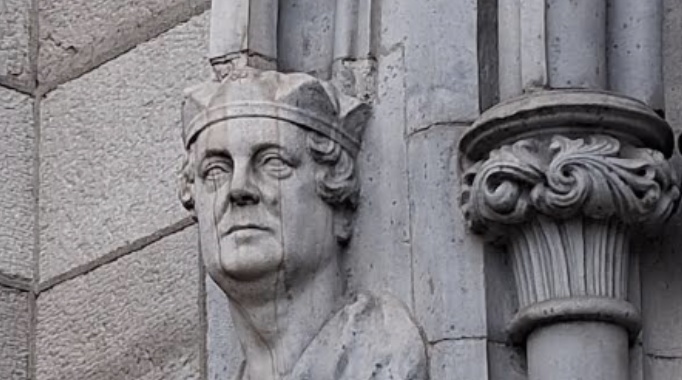
Neither Daniel O’Connell or Fr Canavan lived to see the finished building. They are both remembered in sculptured corbel heads, place either side of the main church door.
Daniel is depicted wearing a crown as King of Ireland.